Technology
The Transformative Role of Technology in Modern Trading

Your large order leaves a footprint. That footprint is called market impact - and it costs you money.
Every large order you place in the market leaves a footprint. Suppose you want to buy 5,000 shares of a liquid Nifty 50 stock and place a market order. By the time the fill report appears, you have paid ₹0.50 more per share than the price you saw just moments ago. That is not bad luck, it is called market impact. And it is the exact problem that execution algorithms are designed to solve.


Execution algorithms are your defense. They are high-performance systems designed to dismantle large orders into smaller slices, executing them over time based on real-time liquidity and volatility. At BlitzTrader, our algorithms don't just execute; they protect your edge by minimizing impact and capturing the best possible price.
In Indian markets, the stakes are especially high. With retail participation surging, FIIs and DIIs moving large blocks, and volatility spiking during events like budget announcements or expiry days, the gap between your decision price and your executed price can eat away even the most well-researched trade. Whether you are trading equity cash, NSE F&O, or commodity futures on MCX, how you execute matters as much as what you execute.
The concept is straightforward, instead of placing your entire order in the book at once, you break it into smaller slices and release them gradually, following rules designed to reduce costs or improve returns.
These rules vary where some focus on time, others on volume, and some on your target price but the objective is always the same: execute efficiently without pushing the market against yourself.
Execution algorithms make little sense for small trading amounts and are often overkill. If you are trading just 50-100 shares of a mid-cap stock or a few lots of Bank Nifty options, your order is simply too small to move the market. Available liquidity at the top of the order book can easily absorb you, and the market impact cost is negligible and often just a few paise or one tick. At this scale, hitting the market or placing a simple limit order works perfectly fine. Adding an algorithm only adds complexity without meaningful benefit. However, when you trade large amounts say 5,000+ shares of a thinly traded stock, 50+ lots of crude oil on MCX during volatility, or a block trade just before F&O expiry the situation changes completely.
Your order is now large enough to consume visible liquidity at the top of the book. Once that liquidity is gone, your remaining slices hit thinner levels and push the price against you, and this market impact cost multiplies quickly. For example, if you want to buy 10,000 shares of a stock showing best ask at ₹100 with only 1,000 shares available, without an algorithm you take the first 1,000 at ₹100, the next 1,000 at ₹100.10, then ₹100.20, and so on - your average price keeps climbing. That slippage is market impact, and it directly erodes your returns. Execution algorithms do not give you magical prices, but they help you hide your true size, participate gradually, and avoid pushing the market against yourself. For small orders, you do not need that protection. For large orders, skipping it means leaving money on the table.
For proprietary trading desks and high-net-worth individuals operating across NSE, BSE, and MCX, execution algorithms are no longer a luxury. A desk running 200 lots of gold futures through a trending session without algorithmic slicing is leaving money on the table. Implementation shortfall - the gap between your decision price and your average fill - is measured, tracked, and optimized. Every tick matters, especially in high-beta sectors or during intraday swings.
For broking houses and fintech firms offering algo trading to clients, execution algorithms are now table stakes. With SEBI's framework for algo trading and the rise of colocation and proximity hosting, retail and institutional clients alike expect smart execution. Providing TWAP, VWAP, iceberg, and participation-based algorithms directly inside your trading platform is no longer a differentiator - it is a baseline requirement.
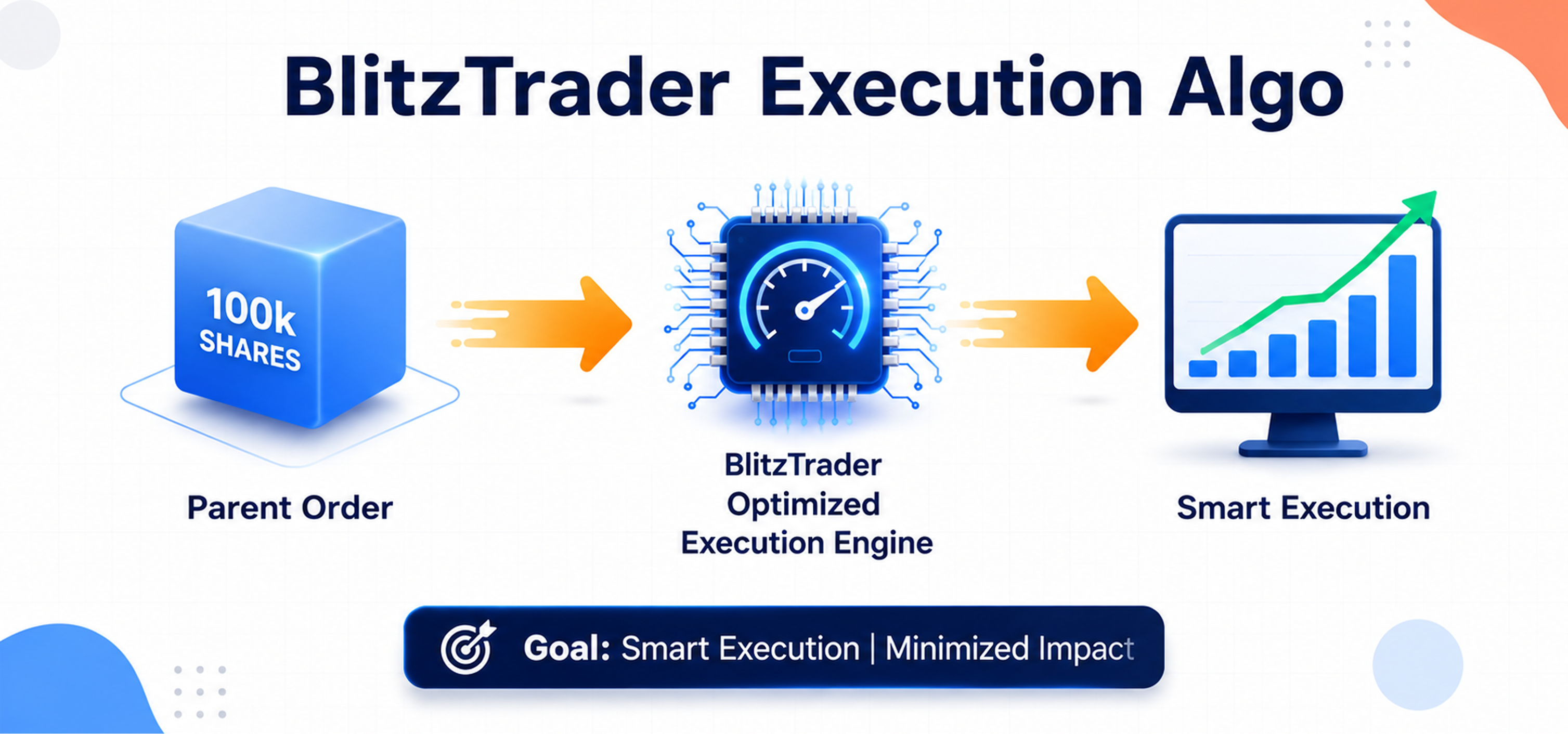
Execution algorithms differ primarily in how they slice an order across time and volume.
TWAP (Time-Weighted Average Price) splits the order evenly over fixed time intervals, making it ideal for stable, predictable liquidity.
VWAP (Volume-Weighted Average Price) aligns execution with actual market volume-executing more during busy periods and less during lulls—to track the day's average price.
An Iceberg Order hides the true order size by showing only a small portion in the order book, replenishing it as trades occur, which helps avoid front-running.
Smart Order Routing (SOR) dynamically decides where and how to send each slice-choosing between NSE and BSE, or between limit and market orders-to get the best possible fill.
The Participation Rate Algorithm caps your execution as a fixed percentage of market volume (e.g., 10%), ensuring you blend in without dominating trading activity.
Arrival Price Algorithm (also called Implementation Shortfall) focuses on minimizing slippage from the price at the moment you decided to trade, balancing urgency against market impact in fast-moving conditions.
Market Impact The price movement caused by your own order's execution. Large market orders consume available depth and push price against you. This is the primary cost that execution algorithms are designed to minimize.
Implementation Shortfall The difference between your decision price - when you decided to trade - and your actual average execution price. This is the gold-standard metric for measuring execution quality in institutional settings.
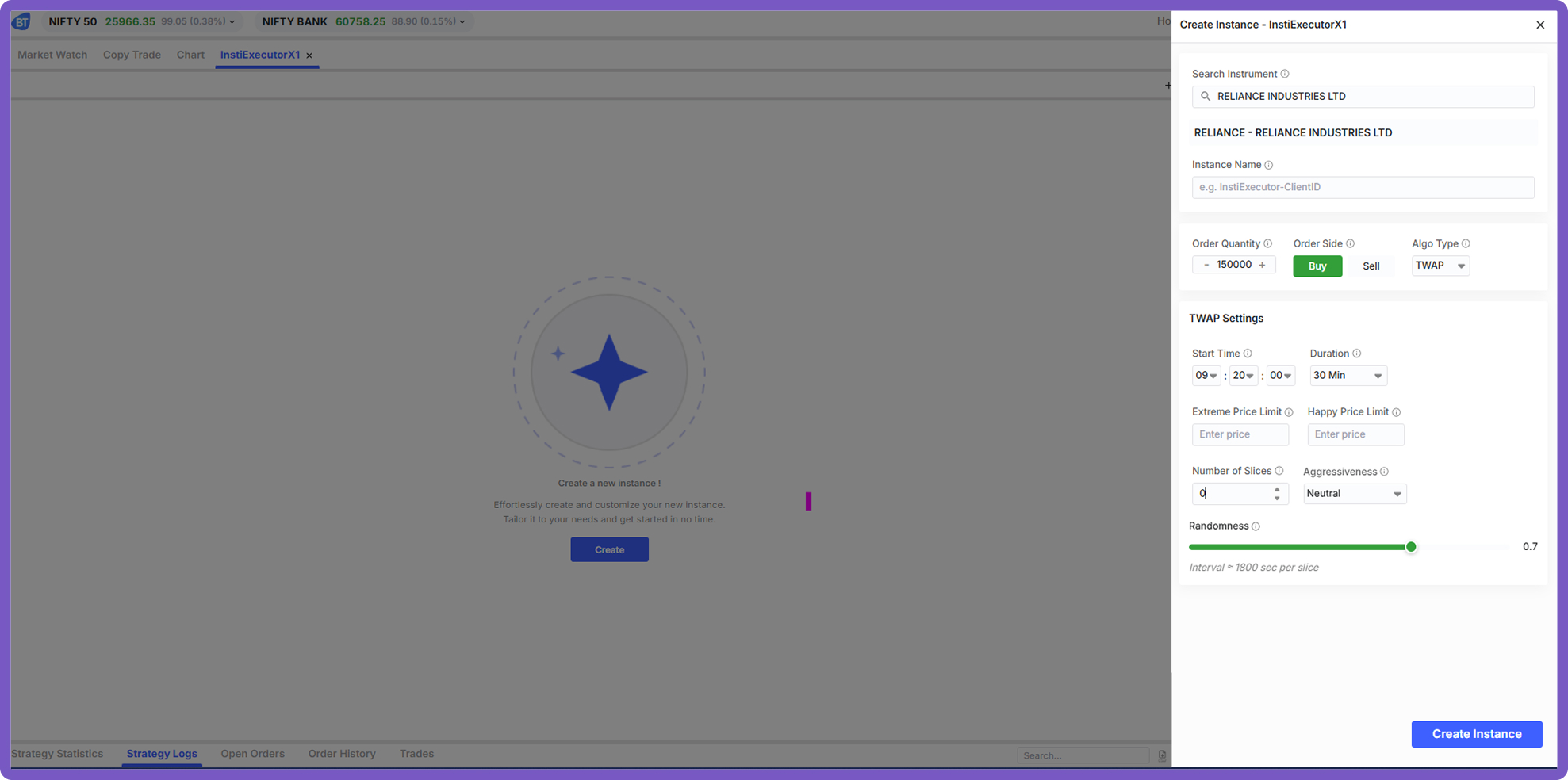
Execution algorithms are not just for institutional traders anymore. As Indian markets mature, liquidity deepens, and competition intensifies, the ability to execute efficiently is becoming a core competency for proprietary desks, fintech firms, and even sophisticated retail traders. Whether you are using a simple TWAP to smooth out your entry or a full arrival price algorithm to protect your decision price, the tools are available and understanding them is the first step to keeping your edge.


